18 Park Circus
Poor Things18 Park Circus is the Glasgow residence at the centre of the intertwined lives of Godwin Baxter, Archibald McCandless, Bella Baxter, and Victoria McCandless. First a shadowy private home with a garden full of animals and a laboratory-like dining room, it becomes the setting for a marriage, a death, and a refuge from coercive domestic life. In later decades its rooms accommodate students, patients, political activity, and artists, so that a single address carries the story from Baxter’s private experiments into Victoria’s public work and its uncertain legacy.
House, Garden, and Household
The house is introduced as a tall, gloomy terrace in Park Circus. Its lobby is crowded with a Newfoundland dog and the noisy welcome of two Saint Bernards, an Alsatian, and an Afghan hound. Rather than receiving McCandless in an ordinary room, Baxter leads him down to the basement and out into a narrow garden enclosed by high walls. A paved section holds a wooden dovecote and pigeons; beyond it are vegetable plots, a fenced lawn, rabbit hutches, and tame rabbits. The confined garden gives the house a small, self-contained world of animals, cultivation, and close observation.
The rabbits make that domestic setting an extension of Baxter’s unusual scientific work. He asks McCandless to examine two animals whose black-and-white coats divide at the waist in precisely opposed patterns. The scene places a possible biological anomaly not in a public laboratory but in the walled garden behind the family home. Elsewhere in the house, animal care also becomes practical work: after returning from abroad, Baxter establishes a small veterinary clinic and Bella serves as receptionist and assistant, treating sick animals and learning to stitch wounds. The house is therefore not only where Baxter keeps and studies animals; it is also where Bella acquires medical experience through their care.
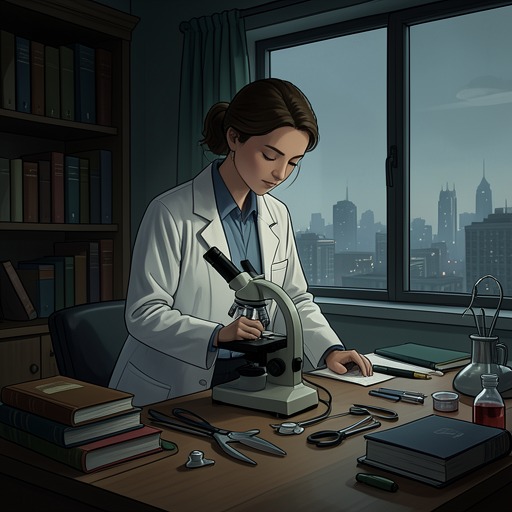
The household’s strangeness continues at the dining table. McCandless eats with Baxter at a huge table, sitting as far away from him as possible. Baxter, who has little or no pancreas, makes digestive juices by hand and adds them to his food; a sideboard behind his chair is crowded with carboys, vials, measuring glasses, pipettes, syringes, laboratory papers, thermometers, and equipment for distillation. The equipment bubbles over a low gas flame through the day. Baxter sometimes stops eating and stands still as if listening inwardly. These details make the house a place where bodily difference is neither concealed nor separated from ordinary domestic routine: medical apparatus, meals, servants, animals, and friendship occupy the same household.
Marriage, Residence, and Loss
The address is central to the official record of Bella and McCandless’s relationship. On 10 January 1884, by special licence, they sign a civil marriage contract at 18 Park Circus. The bride, groom, and witnesses—Baxter and his housekeeper, Ishbel Dinwiddie—are all resident there. The marriage thus takes place within the same household that has shaped Bella’s life and where Baxter has acted as her guardian. The address is not a ceremonial venue used only for the occasion; it is also the home shared by the people who witness the contract.
Baxter dies at the house on 16 April 1884. McCandless, now a medical doctor, signs the death certificate, which attributes the death to a cerebral and cardiac seizure provoked by hereditary neural, respiratory, and alimentary dysfunction. The report of the burial notes a uniquely shaped coffin, and Baxter leaves his entire estate to Dr. and Mrs. McCandless. The house consequently passes from Baxter’s unusual bachelor household into the couple’s possession, along with the inheritance on which their future work will partly depend.
The rooms also become the destination for people escaping other households. McCandless later recalls arriving by cab with a woman whose husband was expecting a child by a younger servant. Baxter asks Mrs. Dinwiddie to treat the visitor as his sister and gives her shelter. The episode recalls Baxter’s own relationship with his unmarried mother: unlike a father who withheld recognition, Baxter openly acknowledges and loves Mrs. Dinwiddie. At 18 Park Circus, then, hospitality is shaped by a domestic bond that the wider social order might treat as disreputable, and the house offers protection to a woman who has been badly treated.
A Refuge and a Contested Identity
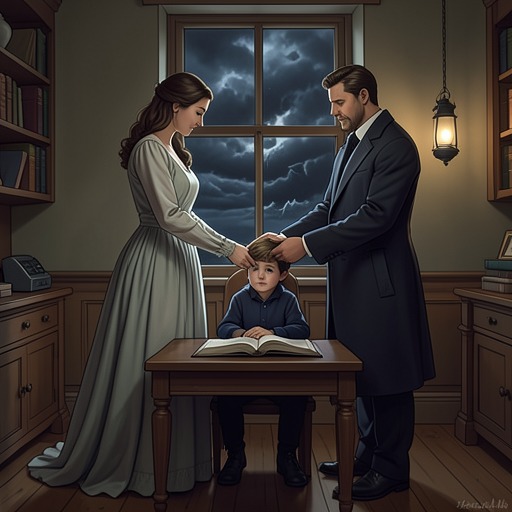
The house becomes a refuge again when the circumstances of Bella’s identity are challenged. At a church where McCandless and Bella intend to marry, men claiming authority over her press their case, and a medical adviser argues that Bella resembles Lady Blessington. Baxter insists that any discussion include Bella and take place in his home, rejecting the safety of a private conversation from which she would be excluded. He arranges for Mrs. Dinwiddie and the visitors to go ahead to 18 Park Circus, while he, Bella, and McCandless return on foot. His insistence makes the house more than a convenient meeting place: it is the setting he chooses to keep Bella present and involved when men seek to determine who she is and what may be done with her.
That defence relies in part on Baxter’s account of Bella as an amnesiac ward who came to him three years earlier, and on his will leaving her his estate. The explanation he offers to others is itself a carefully constructed story. He invents South American married cousins who died in a train crash and an amnesic daughter called Bella Baxter to conceal Victoria’s history as the runaway wife of General Sir Aubrey de la Pole Blessington. At the house, Victoria can be sheltered under this invented identity; the address protects her while also becoming part of the fiction that conceals her past.
Victoria’s Clinic and Political Life
After Victoria and McCandless open the Godwin Baxter Natal Clinic in 1890, they put Baxter’s money into its supporting fund. By 1920, after the managing committee has changed, Victoria is dismissed and the clinic is transferred to Oakbank Hospital as an outpatient department. Having spent her savings printing, distributing, and advertising A Loving Economy, she has only 18 Park Circus left. She lets the upper rooms to university students and withdraws to the basement, where she continues the clinic on a much smaller scale under Baxter’s name. The house thus changes from an inherited asset into the last remaining base for her medical work.
A later newspaper account gives the basement clinic a vivid material form. Children call Victoria the Dog Lady because she walks through West End Park with dogs of different sizes, some bandaged. The clinic is entered from a back lane, and rhubarb grows over the ground beside the path. Its waiting room is crowded with heavy mid-Victorian furniture, including a large horsehair-covered sofa; old posters for the Scottish Workers’ Republican Party are the only wall decorations. A padlocked box invites people to contribute what they can afford and tells hungry visitors to ask for help rather than steal. The waiting patients include poor older people and children with animals, while the surgery itself is a gas-lit kitchen with soup on the range, animals in the corners, and books, papers, and medical instruments spread across the table.
The house also serves as a place for political association. When John Maclean founds the Scottish Workers’ Republican Party rather than joining the newly formed British Communist Party, Victoria offers him her home as a meeting place. Her support for him continues until his death in 1923, after which she speaks at his graveside. In this period, 18 Park Circus is not simply where Victoria practises medicine: it is also a domestic setting made available to a political movement, and a base for the social commitments that persist after the original clinic has been taken from her.
Later Uses and Narrative Significance
During the Second World War, Glasgow’s industrial and cultural life revives, and 18 Park Circus takes on another use. Margaret Morris rents an upper floor for rehearsals by her Celtic Ballet Company. Until 1945 the house becomes one of several informal arts centres in or near Sauchiehall Street. Painters, including Robert Colquhoun, Stanley Spencer, and Jankel Adler, lodge there briefly or visit; poets such as Hamish Henderson, Sidney Graham, and Hugh MacDiarmid are also among its visitors. The upper rooms that had been let to students now support artistic activity, while Victoria remains a comparatively obscure presence in the basement.
That division between upstairs and below ground echoes the house’s earlier layering of public appearances and concealed histories. To later visitors Victoria is an elderly landlady, a healer, and a provider of soup; MacDiarmid recognizes her as a woman whose medical importance deserves comparison with celebrated scientists and physicians. The address has held Baxter’s experiments, Bella’s marriage, Victoria’s refuge and clinic, political meetings, and artistic gatherings without reducing them to one stable identity. Its significance lies in that accumulation: 18 Park Circus repeatedly gives private, marginal, or threatened lives a place to continue, even as the world outside contests their identities, work, and right to belong.